Minoxidil
Extends the growth phase.
A potassium channel opener. Its active metabolite promotes vasodilation and prolongs the anagen phase, pushing resting follicles back into growth. It does nothing to the androgen signal itself.

Comparison
Minoxidil pushes the follicle to grow. Clascoterone blocks the signal that shrinks it. They act at opposite ends of the same problem, which is why comparing them as rivals misses the point.
Minoxidil
Extends the growth phase.
A potassium channel opener. Its active metabolite promotes vasodilation and prolongs the anagen phase, pushing resting follicles back into growth. It does nothing to the androgen signal itself.
Clascoterone
Competes for the receptor.
An androgen receptor antagonist. It competes with DHT for the receptor inside the dermal papilla, which is the upstream driver of patterned hair loss rather than the downstream growth phase.
In short: minoxidil pushes the follicle to grow; clascoterone blocks the signal that shrinks it.
| Feature |  Minoxidil Minoxidil | 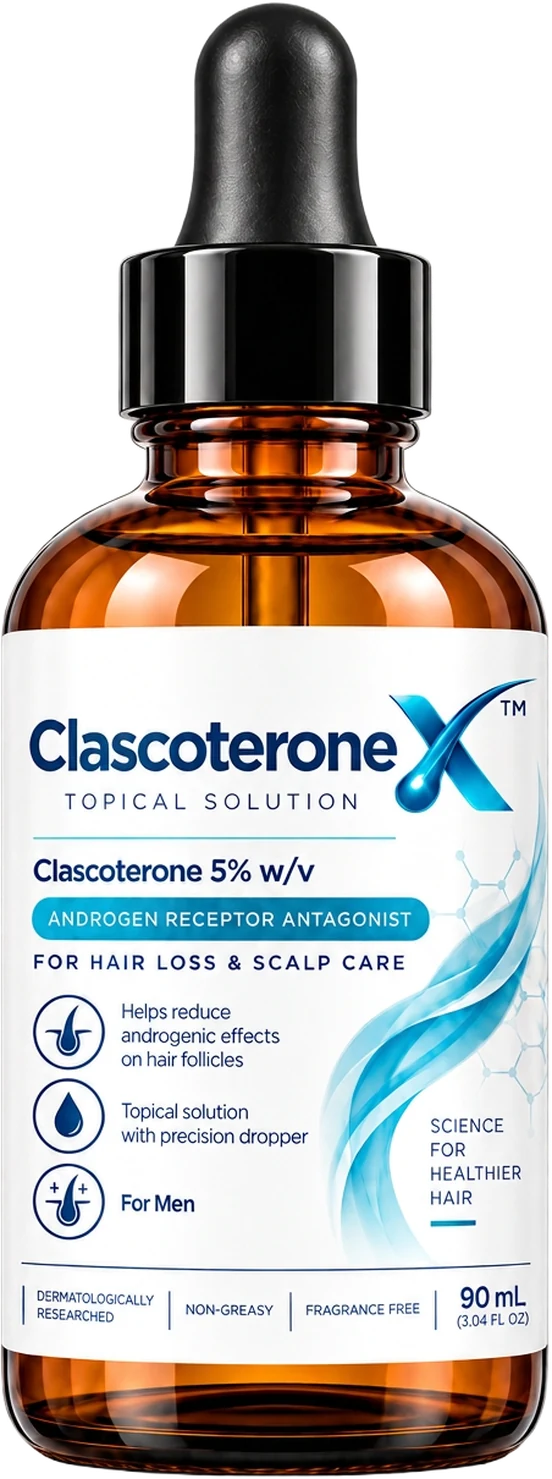 ClascoteroneX ClascoteroneX |
|---|---|---|
| Hair result reported in its own studies | 40%* | Up to 539%* |
| Acts on the androgen signal behind the loss | No | Yes |
| No shedding phase expected at the start | No | Yes |
| No unwanted facial or body hair growth reported | No | Yes |
| Carries no chest-pain or rapid-heartbeat warning | No | Yes |
| Not a repurposed blood-pressure medicine | No | Yes |
| No headache reported in use | No | Yes |
| Free from propylene glycol | No | Yes |
| Rapidly metabolised to an inactive form | No | Yes |
Disclaimer: Minoxidil is an approved medicine for regrowth that works by extending the growth phase of the hair cycle. ClascoteroneX is a cosmetic scalp-care solution that acts on the androgen signal linked to thinning. One extends the growth phase; the other targets the signal at the root. Individual results vary; this comparison is for informational purposes and is not a medical claim.
Comparison reflects minoxidil's own product information and published study results. The two hair-result figures come from different study designs and are each as reported in their own studies, not measured head-to-head. Individual results vary.
Each row comes from the sources listed at the foot of this page. Minoxidil has its own strengths, which the next sections set out: it extends the hair's growth phase, and it is an approved medicine for regrowth with decades of use behind it.
Minoxidil commonly produces a temporary increase in shedding over the first four to eight weeks, as synchronised resting hairs are released before new ones replace them. It is expected and self-limiting, but it is the part people dread.
Clascoterone does not force that cycle reset. Its early observable endpoint tends to run the opposite direction — a gradual reduction in daily shed count.
Minoxidil solutions often contain propylene glycol, a frequent cause of scalp irritation and contact dermatitis — which is why foam formulations exist at all.
In the large Phase 3 acne programme, topical clascoterone's local reactions were predominantly mild and limited to the application site.
No. Mechanistically they are complementary rather than redundant: one addresses androgen signalling, the other prolongs the growth phase. Many clinicians consider combination approaches for exactly that reason.
That said, combining actives increases the chance of scalp irritation and makes it harder to attribute a result — or a side effect — to one product. If you intend to layer them, do it with clinical supervision and introduce one change at a time.
Minoxidil is an approved medicine for hair regrowth with decades of use behind it. Clascoterone's published record comes from the acne programme, where 1% cream was studied in more than 1,465 patients across two Phase 3 trials; scalp research is at an earlier stage.
ClascoteroneX is a cosmetic scalp-care solution, not a medicine, and published ingredient research does not establish outcomes for a specific cosmetic product. Ingredient comparisons are educational and are not a recommendation to begin, stop, or combine products.
1.5 mL twice a day from a calibrated dropper. One 90 mL bottle covers 30 days.